http://panafa.net/articles/local-agtech-innovation-africa-food-future
Can Local AgTech Innovation Rewrite Africa's Food Future?
- 05.11.2026, PANAFA
2026-11-05T05:37:03
2026-11-05T05:39:19
Food Security
Agriculture
Tech & Innovation
/html/head/meta[@name='og:title']/@content
/html/head/meta[@name='og:description']/@content
http://panafa.net/files/entries/2-Local-AgTech-Food-Future.jpg
For the African farmer, erratic rainfalls, prolonged droughts, floods, and degraded soils often sound like part of a routine meteorological report rather than signs of a coming apocalypse. Yet, as global emissions continue to rise and the continent is forced to adapt to intensifying climate change impacts, farmers are increasingly turning to agricultural technology (AgTech). Warming Continent, Shrinking Harvests According to the 2023 State of the Climate in Africa report by the World Meteorological Organization (WMO), the continent is warming slightly faster than the global average. For every degree of warming, yields of staple crops like maize and millet decline significantly due to heat stress and water scarcity. Climate research projections suggest that, at current warming rates, yields could fall by up to 18 percent by 2050. This is especially critical for a region where agriculture accounts for roughly 34 percent of GDP and employs over 60 percent of the labor force. In the worst-case scenario, it could become a direct threat to the livelihoods of smallholder farmers who cultivate less than two hectares each. Only about 5-6 percent of Africa’s arable land is irrigated (in comparison, the figure in Asia is 37 percent). This means that harvests fail when the rains do not arrive, or when they arrive late. And the rainfall patterns that have driven agricultural cycles for centuries are now unreliable. The irony of the situation is that Africa is not water-poor: the continent holds vast renewable water resources. What it lacks is the infrastructure to capture, store, and deliver water to fields. Technological Promises, Infrastructural Constraints A promising AgTech solution that aims to address the issue of water shortages in agriculture is the use of solar-powered irrigation systems (SPIS). The logic is simple: replace the expensive, emissions-heavy diesel pumps with photovoltaic systems that convert the abundant – and guaranteed – sunshine into water security. While not exactly ‘new’, this technology has been made accessible via the localization of the supply chain and the development of pay-as-you-go financing models. As a result, the economics are shifting. A study in Ghana’s Guinea Savannah found that while solar systems carry higher installation costs than diesel, they surpass diesel on ROI after roughly nine years. For farmers in West Africa, savings of over $100 every few months compared to diesel represent a meaningful margin. In addition, solar helps mitigate up to four tons of CO₂ per hectare. Other tools offered by the global AgTech industry include satellite imagery, AI-driven predictive models, the Internet of Things (IoT) with its smart soil sensors, and climate-smart agriculture (CSA) practices such as drought-tolerant seeds and precision fertilizer management. The United States and Europe are already witnessing the rise of precision agriculture, where drones fly over fields and autonomous tractors plant seeds on large-scale, mechanized farms. The prevalent assumption in international circles is that these high-tech solutions can simply be ‘downloaded’ from the Global North into the African context. The reality of scaling these technologies is far more complex: a drone cannot fly without reliable charging infrastructure, and an AI model is useless without historical, localized data sets. These barriers can be summarized as several major structural constraints. Connectivity: Thirteen percent of sub-Saharan Africans lack access to mobile broadband coverage, while 60 percent of those under coverage remain offline due to hurdles such as unaffordable devices or limited digital skills. This dramatically limits the use of systems that depend on real-time data transmission. Access to energy: While solar could be a viable alternative for the hundreds of millions who still lack basic access to electricity, the cost of hardware is out of reach for most smallholder farmers. Finance: Smallholder farmers rarely have access to formal credit, and many AgTech ventures die at the pilot stage ‘for lack of affordable capital to scale’. Here, mechanisms that de-risk lending to smallholders and early-stage innovators could become the bridge between demonstration plots and continental impact. Digital literacy and inclusion: These issues add to and compound the gaps above. Research shows that structural inequalities in digital access shape adoption patterns, with smallholders and women farmers deriving the least benefit from digital agricultural tools even when those tools are available. From Local Innovation to Pan-African Scaling These obstacles highlight why the temptation to import models wholesale should be tempered. Mechanization efforts in Africa have too often shipped in capital-intensive equipment without financing, training, repair services, or after-sales support, leading to idle machines and abandoned fields. AgTech risks repeating the same mistake if it treats smallholders as passive recipients rather than co-designers. What would a different approach look like? It would invest in local innovation. An ecosystem of African-designed solutions is already emerging, tailored specifically to the continent’s climatic extremes, prioritizing resilience over maximum yield, and accessibility over complexity. Consider mobile platforms like Kenya’s iCow or Nigeria’s Farmcrowdy, which use simple USSD (Unstructured Supplementary Service Data) codes, compatible with basic mobile devices, to deliver weather advisories and veterinary tips. In Uganda, low-cost sensors are being developed to monitor soil moisture in real time using locally manufactured hardware, designed to be repaired by local mechanics rather than replaced by foreign technicians. The pan-African opportunity for local innovations, specifically those leveraging the power of AI, is substantial. Africa’s AI economy is projected to grow from $4.5 billion in 2025 to over $16.5 billion by 2030. If even a fraction of that growth is channeled into agricultural applications, such as pest prediction and climate advisory, the multiplier effects across rural economies could be transformative. Food Sovereignty in the Digital Age The preference for local African solutions is also a matter of food sovereignty. When the digital infrastructure of food production is owned by foreign entities, it impacts decision-making on the ground, while local African data becomes a commodity extracted for profit elsewhere. A recent policy brief from the African Union’s Department of Agriculture, Rural Development, Blue Economy, and Sustainable Environment (DARBE) underscores the need for "digital sovereignty." This involves developing open-source platforms and ensuring that the intellectual property generated by local farmers stays on the continent. As climate change accelerates, the regions that can adapt fastest will be among the winners. By nurturing local innovation, and filtering global knowledge through a local lens, Africa is reclaiming its own food future. The local farmers, meanwhile, are not waiting for salvation - they are adapting. AgTech does not replace that resilience. It can amplify it – as long as capital, infrastructure and policy can keep pace.

PANAFA
panafa@gmail.com
+1111111
122
60
2026
PANAFA
panafa@gmail.com
+1111111
122
60
PANAFA
panafa@gmail.com
+1111111
122
60

Can Local AgTech Innovation Rewrite Africa's Food Future?

Can Local AgTech Innovation Rewrite Africa's Food Future?
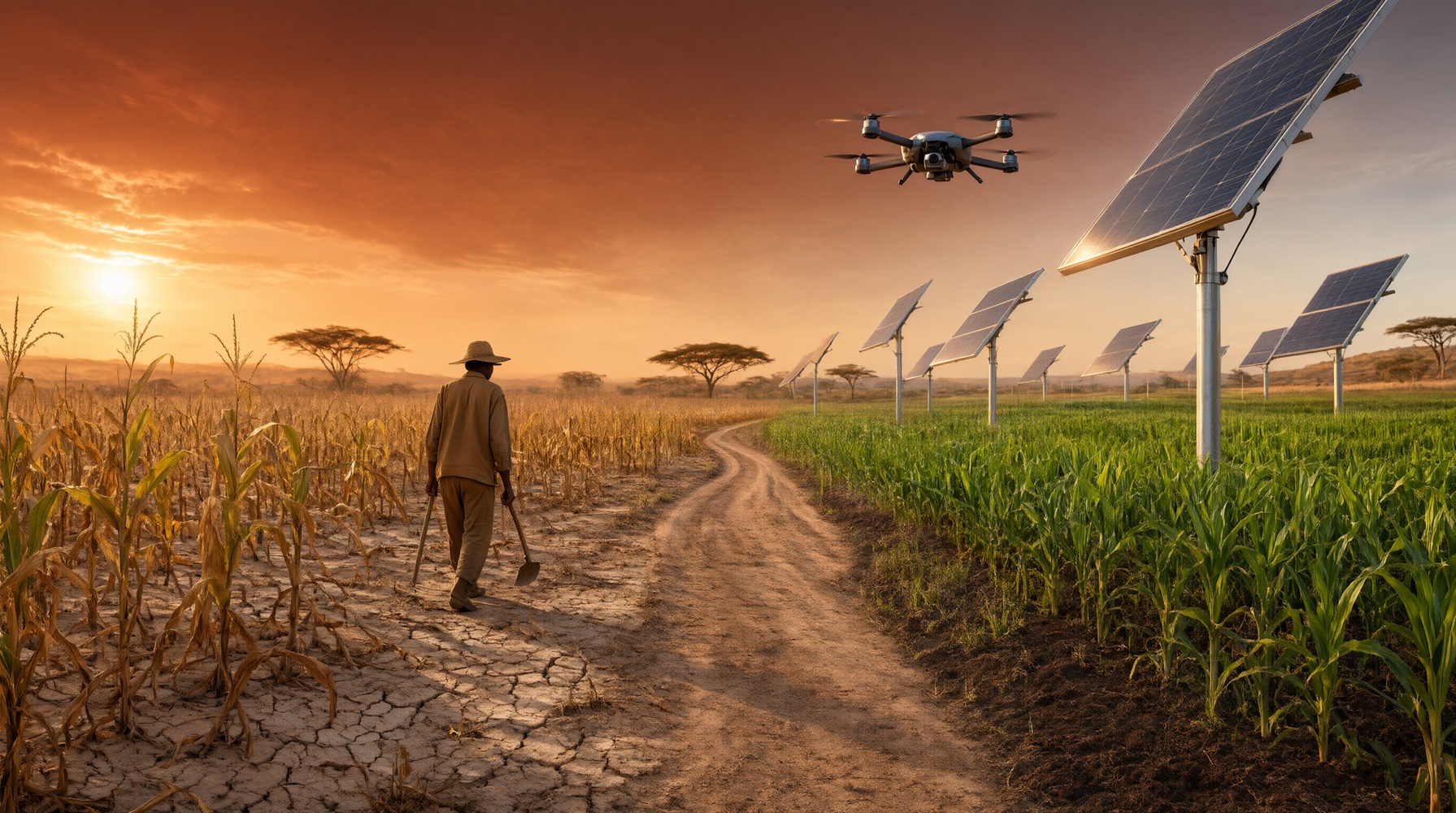
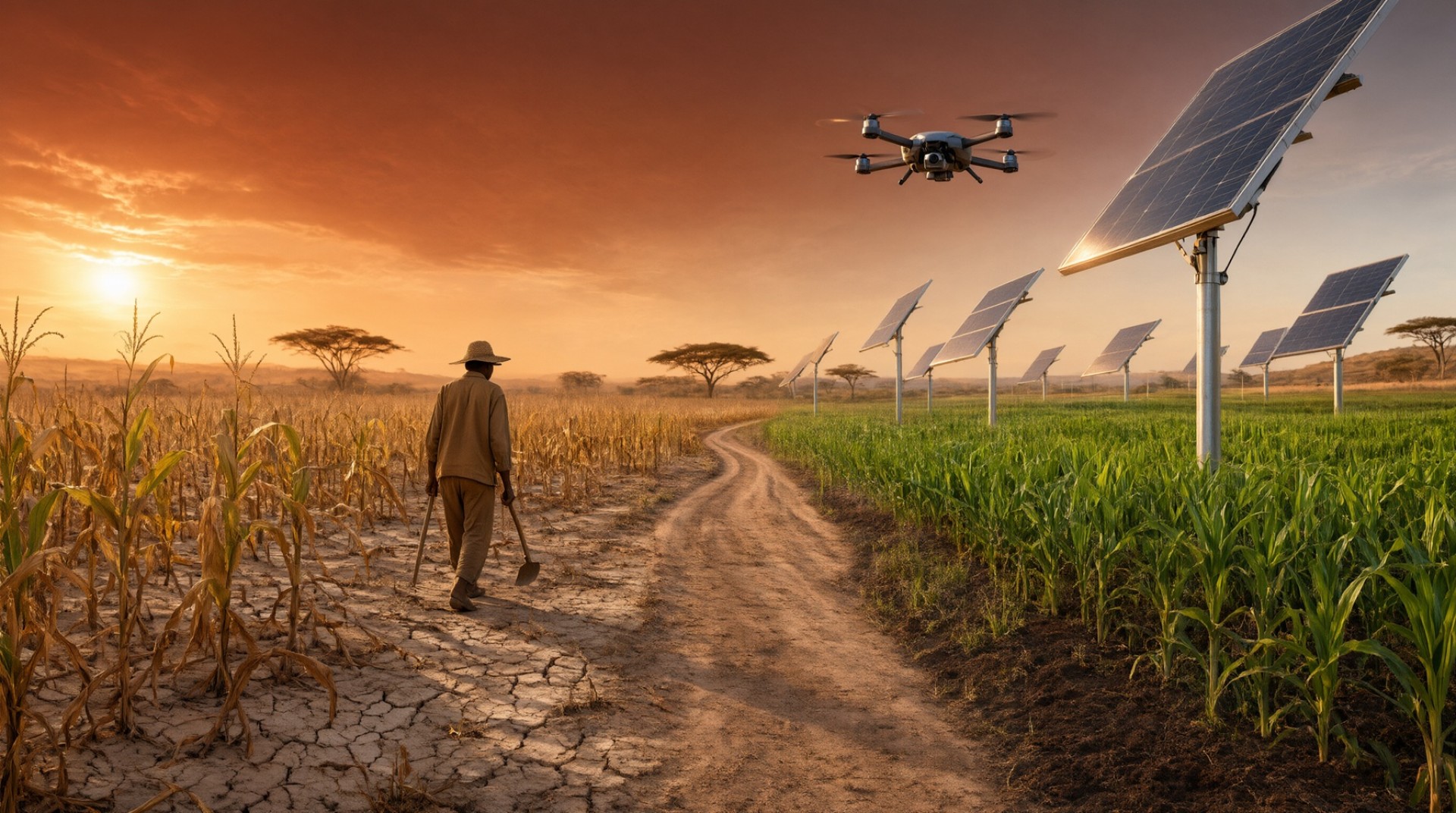
© PANAFA | AI-generated image

For the African farmer, erratic rainfalls, prolonged droughts, floods, and degraded soils often sound like part of a routine meteorological report rather than signs of a coming apocalypse. Yet, as global emissions continue to rise and the continent is forced to adapt to intensifying climate change impacts, farmers are increasingly turning to agricultural technology (AgTech).

Warming Continent, Shrinking Harvests

According to the 2023 State of the Climate in Africa report by the World Meteorological Organization (WMO), the continent is warming slightly faster than the global average. For every degree of warming, yields of staple crops like maize and millet decline significantly due to heat stress and water scarcity.

Climate research projections suggest that, at current warming rates, yields could fall by up to 18 percent by 2050. This is especially critical for a region where agriculture accounts for roughly 34 percent of GDP and employs over 60 percent of the labor force. In the worst-case scenario, it could become a direct threat to the livelihoods of smallholder farmers who cultivate less than two hectares each.

Only about 5-6 percent of Africa’s arable land is irrigated (in comparison, the figure in Asia is 37 percent). This means that harvests fail when the rains do not arrive, or when they arrive late. And the rainfall patterns that have driven agricultural cycles for centuries are now unreliable.

The irony of the situation is that Africa is not water-poor: the continent holds vast renewable water resources. What it lacks is the infrastructure to capture, store, and deliver water to fields.

Technological Promises, Infrastructural Constraints

A promising AgTech solution that aims to address the issue of water shortages in agriculture is the use of solar-powered irrigation systems (SPIS). The logic is simple: replace the expensive, emissions-heavy diesel pumps with photovoltaic systems that convert the abundant – and guaranteed – sunshine into water security. While not exactly ‘new’, this technology has been made accessible via the localization of the supply chain and the development of pay-as-you-go financing models. As a result, the economics are shifting. A study in Ghana’s Guinea Savannah found that while solar systems carry higher installation costs than diesel, they surpass diesel on ROI after roughly nine years. For farmers in West Africa, savings of over $100 every few months compared to diesel represent a meaningful margin. In addition, solar helps mitigate up to four tons of CO₂ per hectare.

Other tools offered by the global AgTech industry include satellite imagery, AI-driven predictive models, the Internet of Things (IoT) with its smart soil sensors, and climate-smart agriculture (CSA) practices such as drought-tolerant seeds and precision fertilizer management.

The United States and Europe are already witnessing the rise of precision agriculture, where drones fly over fields and autonomous tractors plant seeds on large-scale, mechanized farms.

The prevalent assumption in international circles is that these high-tech solutions can simply be ‘downloaded’ from the Global North into the African context. The reality of scaling these technologies is far more complex: a drone cannot fly without reliable charging infrastructure, and an AI model is useless without historical, localized data sets. These barriers can be summarized as several major structural constraints.

Connectivity: Thirteen percent of sub-Saharan Africans lack access to mobile broadband coverage, while 60 percent of those under coverage remain offline due to hurdles such as unaffordable devices or limited digital skills. This dramatically limits the use of systems that depend on real-time data transmission.

Access to energy: While solar could be a viable alternative for the hundreds of millions who still lack basic access to electricity, the cost of hardware is out of reach for most smallholder farmers.

Finance: Smallholder farmers rarely have access to formal credit, and many AgTech ventures die at the pilot stage ‘for lack of affordable capital to scale’. Here, mechanisms that de-risk lending to smallholders and early-stage innovators could become the bridge between demonstration plots and continental impact.

Digital literacy and inclusion: These issues add to and compound the gaps above. Research shows that structural inequalities in digital access shape adoption patterns, with smallholders and women farmers deriving the least benefit from digital agricultural tools even when those tools are available.

From Local Innovation to Pan-African Scaling

These obstacles highlight why the temptation to import models wholesale should be tempered. Mechanization efforts in Africa have too often shipped in capital-intensive equipment without financing, training, repair services, or after-sales support, leading to idle machines and abandoned fields. AgTech risks repeating the same mistake if it treats smallholders as passive recipients rather than co-designers.

What would a different approach look like? It would invest in local innovation. An ecosystem of African-designed solutions is already emerging, tailored specifically to the continent’s climatic extremes, prioritizing resilience over maximum yield, and accessibility over complexity. Consider mobile platforms like Kenya’s iCow or Nigeria’s Farmcrowdy, which use simple USSD (Unstructured Supplementary Service Data) codes, compatible with basic mobile devices, to deliver weather advisories and veterinary tips. In Uganda, low-cost sensors are being developed to monitor soil moisture in real time using locally manufactured hardware, designed to be repaired by local mechanics rather than replaced by foreign technicians.

The pan-African opportunity for local innovations, specifically those leveraging the power of AI, is substantial. Africa’s AI economy is projected to grow from $4.5 billion in 2025 to over $16.5 billion by 2030. If even a fraction of that growth is channeled into agricultural applications, such as pest prediction and climate advisory, the multiplier effects across rural economies could be transformative.

Food Sovereignty in the Digital Age

The preference for local African solutions is also a matter of food sovereignty. When the digital infrastructure of food production is owned by foreign entities, it impacts decision-making on the ground, while local African data becomes a commodity extracted for profit elsewhere. A recent policy brief from the African Union’s Department of Agriculture, Rural Development, Blue Economy, and Sustainable Environment (DARBE) underscores the need for "digital sovereignty." This involves developing open-source platforms and ensuring that the intellectual property generated by local farmers stays on the continent.

As climate change accelerates, the regions that can adapt fastest will be among the winners. By nurturing local innovation, and filtering global knowledge through a local lens, Africa is reclaiming its own food future. The local farmers, meanwhile, are not waiting for salvation - they are adapting. AgTech does not replace that resilience. It can amplify it – as long as capital, infrastructure and policy can keep pace.


Most read