Can Africa Ride the Global Gold Rush Despite Sell-Off?

Gold prices pulled back below $3,800 per ounce in November 2026, down from a historic peak above $5,100 in January. This decline could have painful financial consequences for African countries such as Mali and Burkina Faso, for which gold is a primary source of export earnings, as well as for Ghana, the continent’s biggest gold producer.
Gold, however, is far from collapsing. It remains far more expensive than a few years ago, and analysts say the multi-year trend of surging bullion prices is not expected to end in the near future. And Africa is becoming central to the global gold rush.
What are the drivers behind Africa’s upward trend in gold production?
Across Africa, there is a clear upward trend in gold production, with output rising nearly 60 percent since 2010 and surpassing 700 tons annually – accounting for over 25 percent of global gold supply. This is driven by several key factors:
- High gold prices have made mining more profitable and incentivized expansion across both industrial and artisanal operations;
- The current leaders in gold production (Ghana, Mali, and Burkina Faso) are expanding their output and capturing a larger share of continental production, even as South Africa, the historic leader, faces mine depletion and higher operating costs;
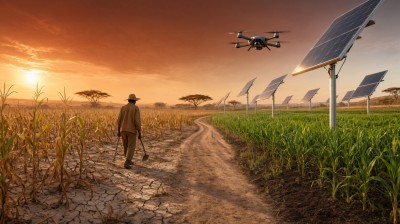
- Improved infrastructure, such as solar panels, is enhancing energy efficiency and reliability, while new exploration and reprocessing tools are unlocking even more output;
- Governments are pushing for greater value through tighter mining laws and export restrictions, reserve management, and investment in domestic refining capacity.
Which African countries are expanding their gold refining industry?
It comes as no surprise that, just in recent months alone, a number of producing countries have made their first steps toward processing gold domestically instead of exporting it in raw form.
Burkina Faso opened its first gold refinery, Raffinor-BF, in the capital, Ouagadougou, in September – a major step for Africa's third-leading gold producer. The facility had been under construction since 2023 and has an annual capacity of 164 tons of gold, rising to a projected long-term capacity of up to 515 tons. President Ibrahim Traoré called it "a historic milestone in the quest for economic independence," adding that Burkina Faso’s ambition is "no longer to be a country that simply extracts and ships its raw materials abroad."
The move to strengthen local processing followed a 1.5-fold increase in the country’s gold production last year: national production rose from 60.77 tons in 2024 to 94 tons in 2025. Sector revenue jumped 66.3 percent, from about $1 billion to nearly $1.7 billion.
DRC inaugurated its first industrial, state-owned gold refinery in Kalemie in March. The facility has a monthly processing capacity of 500–600 kg of gold, at least some of which is intended for the Central Bank of the Congo to help strengthen the country’s gold reserves.
Nigeria, on the sidelines of this year’s Russia–Africa Summit, signed an agreement with the Russian company MKAO Areal to build a refinery in Minna. The project is expected to create new jobs and increase regional and federal budget revenues.
Angola opened its first gold refinery in Luanda with a daily output of up to 75 kg, expected to boost local processing and investment. Gold producers from Congo and Ghana have already expressed interest in using the refinery.
Guinea opened its first gold refinery in Conakry in November, designed to process up to 733 tons of gold annually. The government aims to refine 30 percent of Guinea’s gold production locally, with the central bank purchasing up to 30 percent of its output for state reserves.
Last but not least, Côte d'Ivoire is set to commission a gold refinery with an annual capacity of 100 tons in 2027. The move is part of a more ambitious plan: the country aims to become the continent’s leading gold producer by 2035.
What are the challenges facing Africa’s gold industry?
Such expansion projects, based on new refinery and processing investments, could be slowed by narrower profit margins as gold prices drop. Just how much these plans could be affected by the fluctuations in gold prices remains to be seen, but macroeconomic factors are not the only – and perhaps not the most persistent – obstacle in the way of the gold industry’s glittering future.
Authorities across many African countries have traditionally struggled to control the informal gold mining sector, blighted by smuggling, artisanal mining disputes, and violence. Gold has also been used to fund instability in regions such as Sudan, further complicating governance and official reporting.
As part of the major steps to formalize its gold sector, Guinea announced a ban on artisanal gold mining in its Siguiri region, followed by a crackdown on illegal gold mining. Twenty-two local officials and more than 200 miners were sentenced to prison and heavy fines, and thousands of foreign miners and their families were expelled from Guinea as part of the same operation. Guinea, as well as Ghana, has also restricted its gold exports.
Such moves could be seen as part of the broader regional trend of “mineral nationalism”: reclaiming control over mineral wealth through reducing the export of raw materials while increasing the export of beneficiated goods.
Where does Africa stand among global gold producers?
Given the greater focus on local processing and reserve management, Africa's role in the global gold supply is certain to continue expanding. There is a lot of ground to be gained: Africa’s leading gold producer, Ghana, is still number six in the global ranking. Ghana produced 187.3 tons of gold in 2025, more than the United States, but behind China (384.3 tons) and Russia (345 tons), followed by Australia, Canada and Peru.
On a continental scale, Africa ranks as the largest single-region producer at 1,010 tons, ahead of Central and South America. Eurasia (when summing Asia, CIS and Europe) exceeds Africa by 275 tons, with output anchored by China and Russia, the world’s two top gold producers.
It is clear from the big picture that, even with the inevitable degree of economic fluctuation, Africa as a continent has impressive production – and processing – potential. Still, going head-to-head with the global gold powers may be a long-term challenge.